
At Columbia’s Department of Biomedical Informatics, two new fall courses are tackling the same fundamental challenge from distinct angles: how do we turn today’s flood of health data—from hospital records to smartwatches—into insights we can actually trust and use?
While healthcare systems and consumer technologies generate more information about human health than ever before, raw data alone does not equal insight. Whether buried in an insurance claim or streamed from a fitness tracker, observational data can mislead just as easily as it illuminates—unless we know how to ask the right questions, account for hidden biases, and bridge fragmented systems.
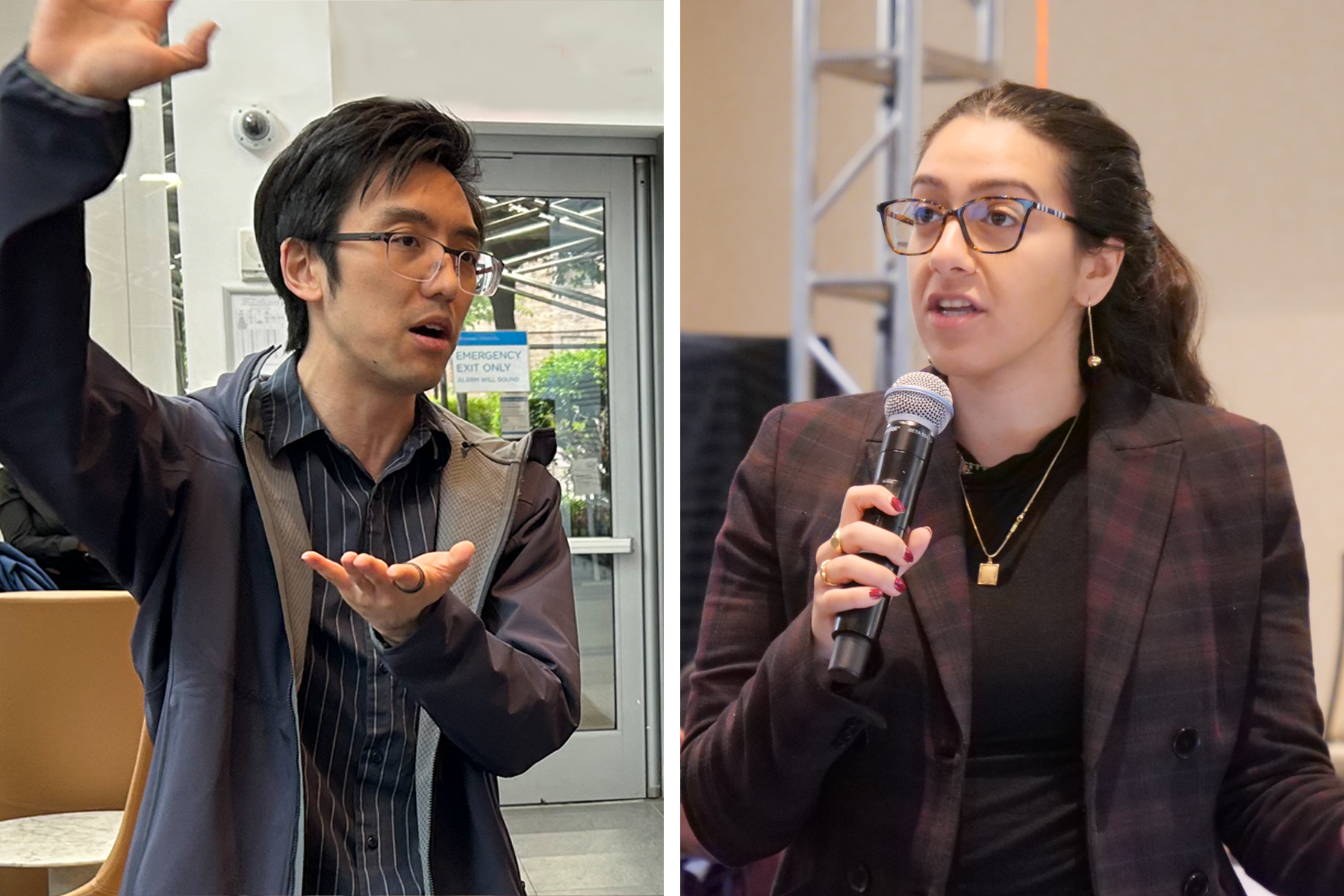
This fall, two new courses take on that challenge from opposite ends of the health data spectrum. BINF 4008: Real World Evidence in Medicine, taught by Professor Tara Anand, equips students to rigorously mine electronic health records and claims data for real-world evidence that can inform clinical and policy decisions, turning messy, raw clinical data into findings clinicians can trust.
“Real-world health data, from electronic health records to insurance claims, hold enormous potential for biomedical discovery, but this potential can only be distilled by careful analyses to correct for and avoid biases that can make a reliable finding into a false claim,” said Anand. “This course teaches students a framework for causal reasoning and inference and how to use tools of the OHDSI network to translate these principles to practice, to design and execute rigorous large-scale observational studies that produce evidence that clinicians and policymakers can trust.”
BINF 4070: The Future of Personal Health Assistant, led by Professor Orson Xu, looks forward, teaching students to build AI-powered systems that make sense of the wearables, sensors, and personal health data increasingly generated outside the clinic altogether.
“Imagine building an AI assistant that can connect the dots between a smartwatch, daily habits, and medical information to answer health questions that no single app can handle today. In this hands-on course, students from computing, health, and design work together with real wearable and health data to create a working personal health assistant,” Xu said. “Along the way, they learn not only how to make AI capable, but also how to make it safe, trustworthy, and genuinely useful to people.”
Together, the courses reflect DBMI’s core mission: training students not just to work with data, but to make it rigorous, trustworthy, and genuinely useful to the people it’s meant to serve. Learn more about each below.
BINF 4008: Real World Evidence in Medicine (Fall semester, Prof. Tara Anand) Fall 2026 Syllabus
Healthcare systems generate enormous volumes of data in various forms, with electronic health records and administrative claims in particular serving as rich sources of information. These real-world health data sources are potential reservoirs of insights for biomedical discovery. Real-world data, however, arises from a data-generating process, shaped by clinical workflow and billing practices, that is distinct from the true biomedical processes we aim to study. This can make distilling reliable insights from these observational data sources challenging. This course introduces the theoretical foundations and practical methods required for addressing these challenges through rigorous observational study design using real-world health data that can be used to generate reliable evidence to answer a range of clinical questions.
Each course topic is developed through three layers of theory, application in informatics, and implementation through tools developed by the Observational Health and Data Sciences and Informatics (OHDSI) consortium, which has developed analytic tools based on best practices for high-quality observational studies. The theory for this course is developed around the frameworks of probabilistic and causal inference, to facilitate understanding of study-design principles and analytic approaches that are thoughtfully informed by domain knowledge. We use theory to understand the challenges and biases of real-world health data, and how observational study design choices and methods can address them. Each stage of the observational study pipeline is covered including formulating a precise research question, identifying the right data, defining study populations and phenotypes, and determining and executing the appropriate analyses.
Tools and conventions developed by the OHDSI community will serve as a practical framework for implementing these concepts. We will examine how OHDSI tools can be used to quickly translate a well-designed research question into an executable study and to evaluate whether the resulting estimates are credible. Each class meeting includes both lecture and hands-on exercises so that concepts are translated into practice as they are introduced.
BINF 4070: The Future of Personal Health Assistant: Multimodal Health Data Management Agents (Fall semester, Professor Orson Xu) Fall 2026 Syllabus
We are currently witnessing an explosion of personal health data. An average individual generates terabytes of health-related data annually through consumer-grade wearables (e.g., Apple Watch, Oura Ring, Fitbit), mobile sensing apps, and genomic services. Simultaneously, their clinical history resides in Electronic Health Records (EHR) systems. Currently, these data streams are fragmented; a physician seeing a patient for depression has no access to their sleep patterns from the last month, and a patient managing diabetes has to manually correlate their diet logs with glucose readings.
The recent rise of Large Language Models (LLMs) and Agentic Workflows offers a transformative solution: the ability to act as a universal “glue” that can reason across heterogeneous data sources. However, building a reliable, privacy-preserving, and medically grounded “Personal Health Assistant” requires a unique intersection of skills that is currently absent in the Columbia curriculum. Computer Science students often lack an understanding of health data standards (FHIR), clinical workflows, and the ethical nuances of patient agency. Conversely, Biomedical Informatics students often lack the systems engineering skills to build robust data pipelines and complex multi-agent orchestrations.
We propose a new interdisciplinary course that merges Data Management and Human-Centered AI for Health. This course will teach students to engineer the full stack of a personal health assistant: from the ingestion and cleaning of noisy sensor data to the architectural design of data pipelines, and finally, to the human-computer interaction (HCI) design of the agent itself. This supports the Collaboratory’s mission by embedding deep computational data literacy into the domain of personal health.