
DBMI Reading Groups
Human-Centered AI Reading Group
The Human-Centered AI (HCAI) Reading Group hosts in-depth discussions on research at the intersection of AI/ML and human-centered design, with a focus on how AI systems can be made useful, usable, safe, and accountable in high-stakes domains such as healthcare. The goal of this group is to build a shared foundation across DBMI—spanning students, research staff, faculty, and engineers—around designing AI systems that work with people (patients, clinicians, and care teams), not just for them
The reading group covers topics including human–AI collaboration, explainability and interpretability in practice, evaluation of real-world AI systems, fairness and bias, trust calibration, LLM-based clinical and patient-facing tools, and the sociotechnical challenges of deploying AI in clinical workflows. Discussions emphasize both rigorous technical ideas and the on-the-ground realities of implementation, including stakeholder needs, workflow integration, and responsible governance.
Since late 2025, the group has also been conducting a systematic review to (1) generate an up-to-date definition of Human-Centered AI in the context of health and healthcare, and (2) develop a practical guideline to inform both academia and industry on designing, evaluating, and deploying HCAI systems responsibly. This effort aims to synthesize fragmented terminology and evidence across disciplines into a shared, actionable framework for the community.
The Human-Centered AI Reading Group is led by Dr. Lena Mamykina and Dr. Xuhai “Orson” Xu. It is open to DBMI faculty, trainees, and staff (and affiliated collaborators across Columbia) who are interested in designing and evaluating AI systems that meaningfully improve health and care delivery.
Healthcare Foundation Model Reading Group
The Healthcare Foundation Model reading group hosts in-depth discussions on cutting-edge foundation models for healthcare at Columbia DBMI. The goal of this group is to develop robust, powerful, and clinically meaningful foundation models for health data at Columbia. The reading group brings together students, research staff, faculty, and research engineers towards building transformative machine learning foundation models with clinical utility in mind.
HL7 FHIR Lab

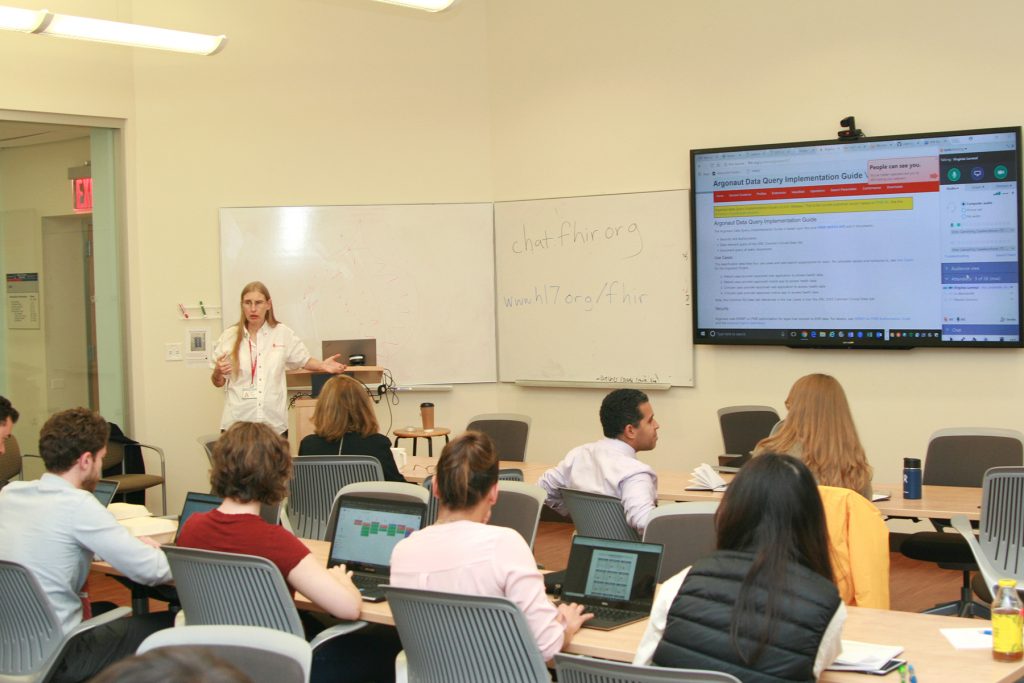
DBMI faculty, students and staff are invited to join the HL7 FHIR (Fast Healthcare Interoperability Resources) Lab, which is designed to create a center of excellence around the use of the HL7 FHIR in our research and service. The mission of the FHIR Lab is to leverage the interoperability opportunities provided by the HL7 FHIR standard to improve patient-centered care, care coordination, and a learning health system. This Lab is intended to be a local collaborative community of learning and activism around this transformative technology for healthcare.
FHIR (Fast Healthcare Interoperability Resources) is an interoperability standard developed by HL7 (Health Level Seven), an international consensus-based standards development organization. FHIR is a powerful interoperability tool for informatics. It provides the promise of a modern way of freeing information for innovation by using modern web technologies such that applications can be deployed that are not tied to a specific large health IT vendor, provider, or payer.
Current use cases in the FHIR Lab include communication about breast cancer risk, depression screening and management, dementia functional staging via mobile app, HIV management including self-management, the CONCERN project for real-time detection of patient decompensation in the ICU, embedded EHR Clinical Decision Support to support EMerge, and more.
The lab is open to students, faculty, and staff at Columbia, Weill Cornell, and NewYork-Presbyterian with a common interest in FHIR.
The FHIR Lab is led by Virginia Lorenzi, Dr. Suzanne Bakken, and Mark Israel, who share a similar passion for the potential of standards to create a more interoperable healthcare system.
Collaboration in the FHIR Lab takes place one Thursday each month (2 pm ET) over Zoom. The FHIR lab is open to all students, faculty and staff at Columbia, Cornell, and NYP. To receive the Zoom invite or to learn more, please contact Virginia Lorenzi at vl98@cumc.columbia.edu.